
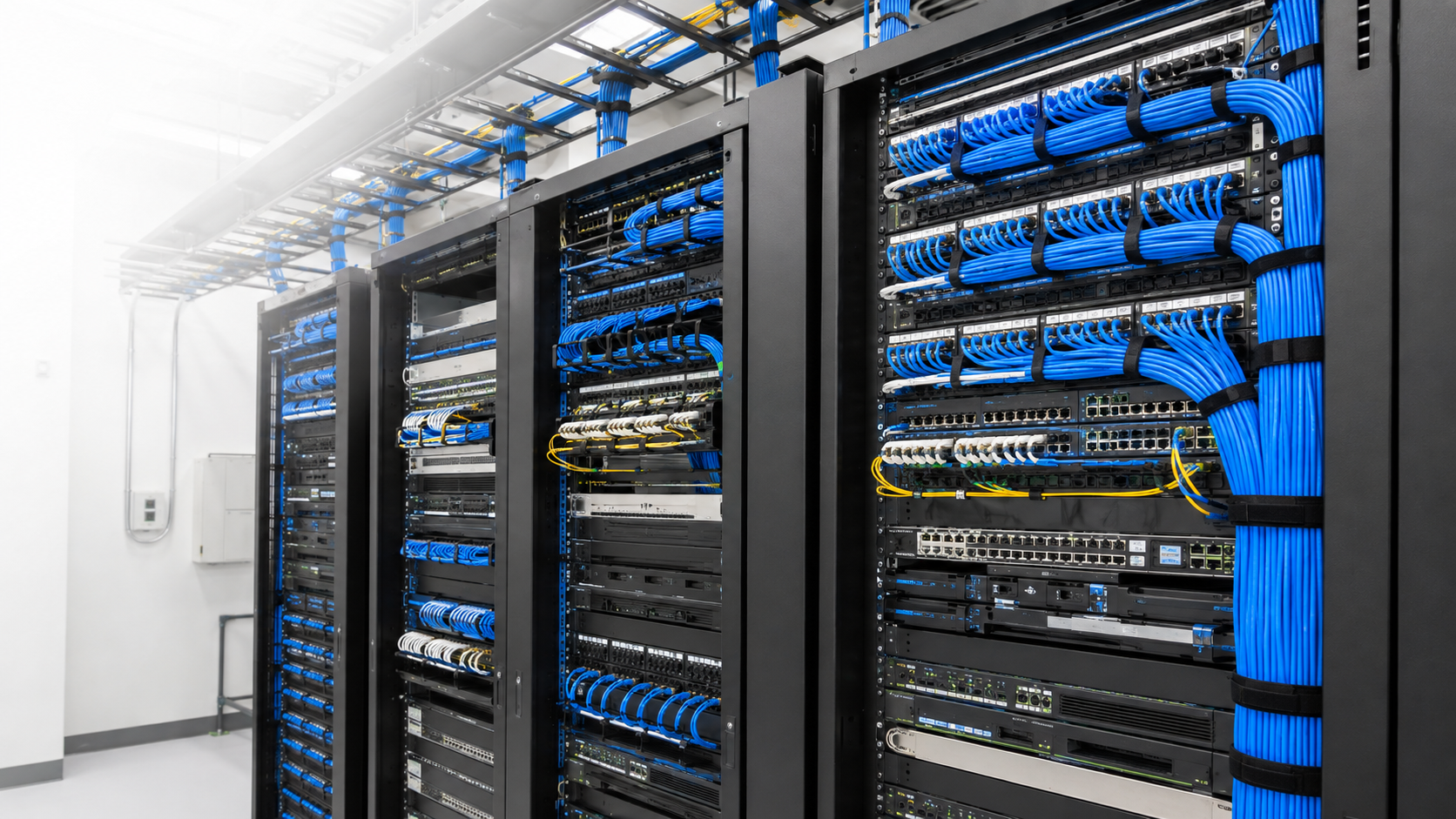
Structured Cabling for Commercial Buildings
Voice & Data Infrastructure Basics
Short Answer
Structured cabling is the organized, standardized wiring backbone — Ethernet cable, fiber optic runs, patch panels, and termination points — that carries voice, data, and often building-system traffic (security, access control, AV) through a commercial building. Poorly planned cabling causes problems for years; it’s one of the more consequential infrastructure decisions in a build-out because it’s expensive to redo later.
Core Components
- Horizontal cabling: Runs from a telecom room to individual workstations or devices, typically Cat 6 or Cat 6A copper
- Backbone/riser cabling: Connects telecom rooms and floors together, often fiber optic for longer runs and higher bandwidth
- Patch panels: Organized termination points that make moves, adds, and changes manageable
- Telecom/IDF rooms: Where cabling concentrates and connects to active network equipment
Copper vs. Fiber
Copper (Cat 6/6A) handles most standard workstation and device connections cost-effectively over shorter distances. Fiber optic cabling is used for backbone connections between floors or buildings, and increasingly for high-bandwidth applications, since it supports much longer distances without signal degradation and isn’t subject to electromagnetic interference the way copper can be.
One Backbone, Many Systems
Modern commercial buildings increasingly run security cameras, access control, and even some fire alarm and AV components over the same structured cabling backbone as voice and data, rather than each system having entirely separate wiring. This convergence reduces total cabling cost but makes proper initial design more important — a backbone sized only for today’s data needs can become a bottleneck as more systems get added.
Planning for Growth
The most common structured cabling mistake is designing exactly for current needs with no headroom. Pathways, conduit sizing, and telecom room space are far cheaper to over-provision during initial construction than to expand later once walls are closed and ceilings are finished.
Getting Started
HCI Systems designs and installs structured cabling for voice, data, and integrated building systems across California, for both new construction and tenant improvement projects.
Frequently Asked Questions
Do I need Cat 6 or Cat 6A cabling?
Cat 6A supports higher bandwidth over longer distances and is increasingly the standard for new installations, though Cat 6 remains adequate for many standard workstation applications.
Can security and AV systems really share the same cabling as data?
Yes, in most modern designs — but it needs to be planned into the initial cabling capacity rather than added as an afterthought once the network is already at capacity.
How much extra capacity should I plan for?
There’s no universal number, but planning pathways and telecom room space for meaningfully more capacity than your current needs is far cheaper during construction than retrofitting later.