
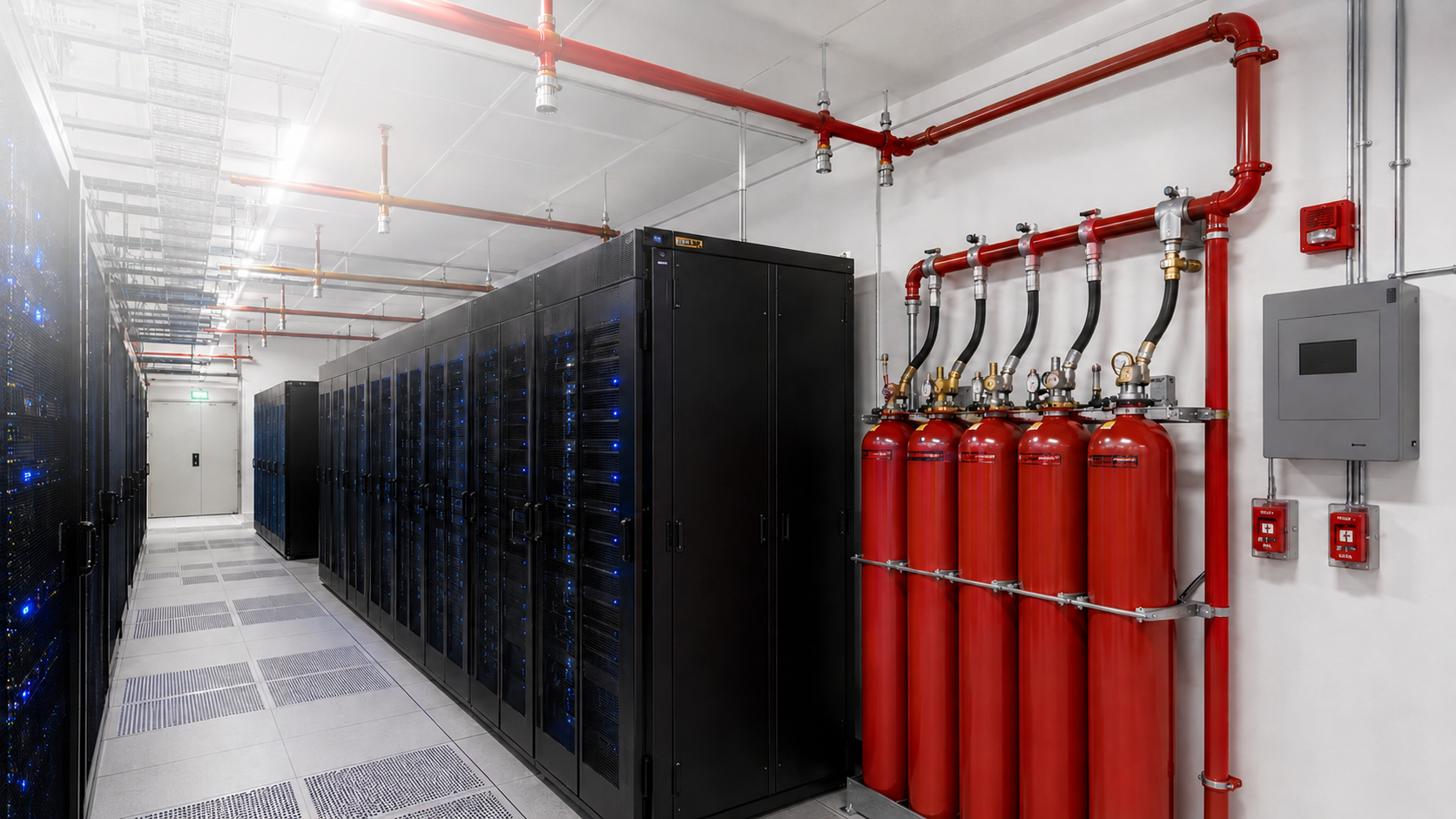
Clean Agent Fire Suppression for Server Rooms
FM-200 vs. Novec 1230
Short Answer
Clean agent fire suppression systems extinguish fires in server rooms and data centers without water or residue, protecting sensitive electronics that would otherwise be destroyed by a traditional sprinkler discharge. FM-200 and Novec 1230 are the two most common clean agents in use today, and while they work similarly, they differ in storage requirements, environmental impact, and cost.
Why Not Just Use Sprinklers?
Water and electronics don’t mix — a sprinkler discharge intended to save a building can destroy the exact equipment it was meant to protect. Clean agents suppress fire chemically and via cooling, without leaving residue or requiring cleanup that would itself damage equipment, making them the standard choice for server rooms, data centers, and similar critical electronics environments.
FM-200
FM-200 has been in commercial use longer and works by disrupting the chemical reaction of combustion while also providing a cooling effect. It requires a specific concentration to be effective and is stored as a liquefied compressed gas. It remains a widely used, well-understood option with a long installation track record.
Novec 1230
Novec 1230 is a newer alternative that works similarly but has a notably lower global warming potential than FM-200, which has made it an increasingly popular choice where environmental impact is a consideration. It’s stored as a liquid at room temperature (rather than compressed gas), which can mean smaller cylinder footprints in some installations.
What Both Systems Require
- Room integrity testing: Confirms the protected space will actually hold the agent concentration long enough to be effective — a room with air leaks won’t work correctly
- Early detection integration: Often paired with VESDA (air-sampling smoke detection) for the earliest possible warning
- Proper concentration calculation: Agent quantity must be engineered to the specific room volume, not estimated
- Periodic inspection and testing: Required on an ongoing basis, not just at installation
Choosing Between Them
For most projects, the choice comes down to environmental considerations, budget, and sometimes local availability of servicing expertise — both are effective, code-recognized options when properly designed and maintained. A qualified fire suppression engineer can evaluate your specific room and recommend which fits your situation.
Getting Started
HCI Systems designs, installs, and services clean agent fire suppression systems for server rooms and data centers across California, including room integrity testing and ongoing inspection.
Frequently Asked Questions
Is Novec 1230 safer than FM-200?
Both are designed to be used in occupied spaces at their designed concentrations. Novec 1230 has a lower environmental impact (global warming potential), which is often the deciding factor rather than a safety difference.
How often does room integrity testing need to happen?
It’s typically required periodically and after any changes to the room that could affect its ability to hold the agent, such as new penetrations, door changes, or HVAC modifications.
Can a clean agent system be added to an existing server room?
Yes, retrofitting is common, though the room’s integrity and layout need to be evaluated to confirm it can properly hold the agent concentration.