
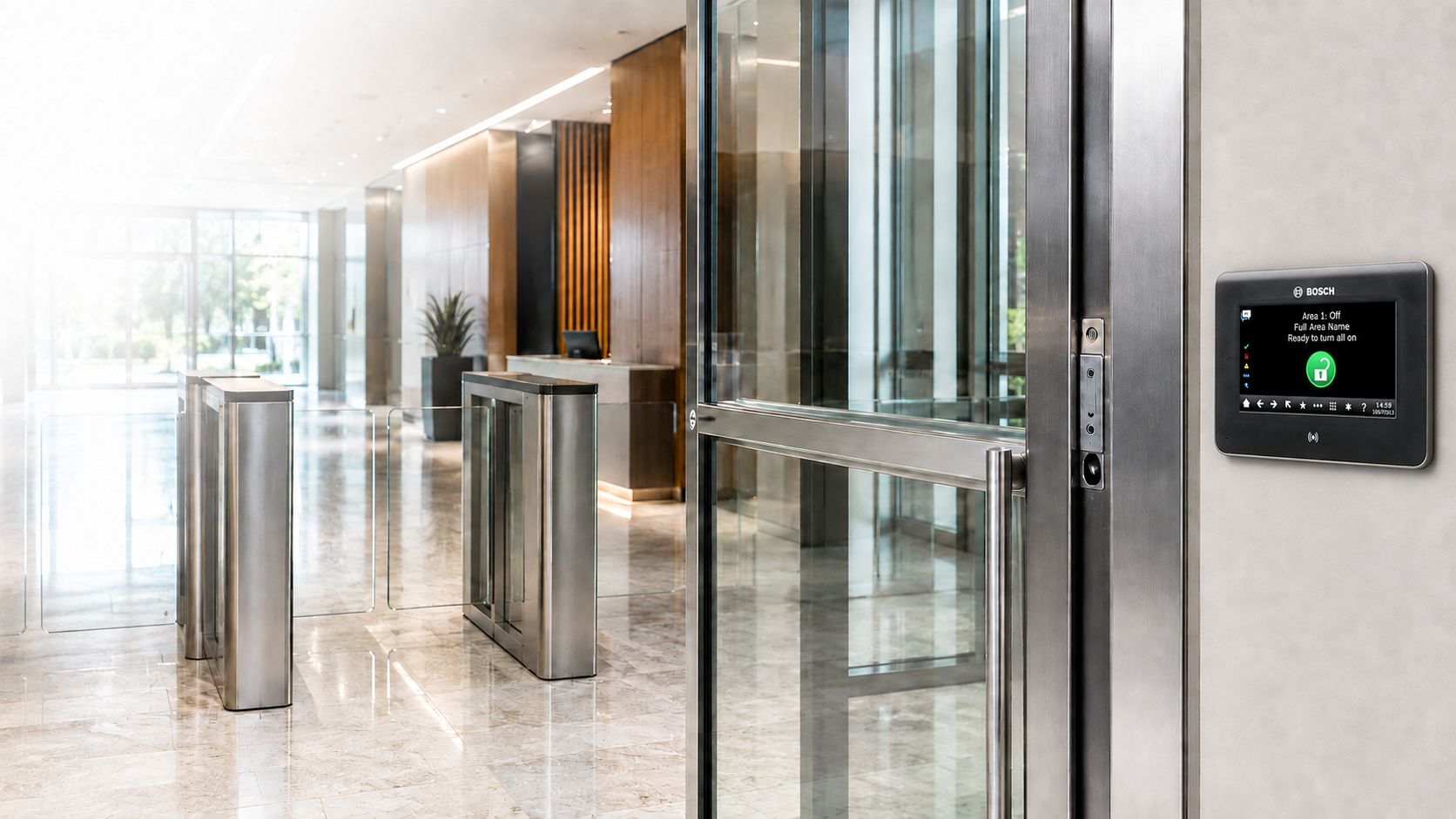
Commercial Burglar Alarm Systems
What California Businesses Need to Know
Short Answer
A commercial burglar alarm system combines intrusion sensors (door/window contacts, motion detectors, glass-break sensors), a control panel, and monitoring service to detect unauthorized entry and alert either your team or a monitoring center. The right setup depends on your building layout, what you’re protecting, and how fast you need a response.
Core Components
- Door and window contacts: Detect when an entry point opens
- Motion detectors: Cover open areas like lobbies, warehouses, and hallways
- Glass-break sensors: Detect the specific sound frequency of breaking glass, useful for storefronts
- Control panel: The brain of the system — arms, disarms, and reports events
- Keypads and credentials: How authorized users arm/disarm the system
Monitored vs. Unmonitored Systems
An unmonitored system sounds a local alarm but doesn’t notify anyone automatically — it relies on someone nearby hearing it. A monitored system reports to a central monitoring station 24/7, which can dispatch police or notify designated contacts even if no one is on-site. For most commercial properties, monitored service is the standard, since break-ins often happen outside business hours.
Reducing False Alarms
False alarms are the most common complaint with commercial intrusion systems, and repeated false dispatches can lead to fines from some California municipalities. The most effective fixes are usually proper motion-sensor placement (avoiding HVAC vents and areas with moving shadows), staff training on arm/disarm procedures, and video verification — where a monitoring operator can visually confirm an intrusion before dispatching police, rather than relying on the sensor alone.
Integration With Other Systems
Modern commercial burglar alarm systems rarely stand alone. Integrating intrusion detection with access control (so a door forced open outside business hours triggers an alarm) and video surveillance (so an event automatically pulls up the relevant camera feed) gives a much more complete picture than any one system alone.
Choosing the Right System
The right setup depends on your risk profile: a single-tenant office has different needs than a multi-tenant warehouse or a retail storefront with public foot traffic. A site assessment from a licensed integrator is the best way to identify vulnerable entry points and design coverage around them rather than guessing at sensor placement.
Getting Started
HCI Systems designs, installs, and monitors commercial intrusion detection and security systems across California, integrated with access control and video surveillance where needed.
Frequently Asked Questions
Do I need monitored service, or is a local alarm enough?
For most commercial properties, monitored service is worth it — an alarm that only sounds locally after hours often goes unheard until the next business day.
Can burglar alarms integrate with my existing access control system?
Yes, in most cases. Integration lets a forced door or after-hours entry trigger an alarm automatically instead of relying on a separate system.
What causes most false alarms?
Motion sensors placed too close to HVAC vents, windows with moving shadows, or staff not following proper arm/disarm procedures are the most common causes.